
In the world of modern web development, APIs (Application Programming Interfaces) form the backbone of how clients and servers communicate. With the increasing demand for efficient, flexible, and scalable data fetching methods, developers often face a critical choice between two dominant API paradigms: REST and GraphQL. Both have their strengths and weaknesses, shaped by different design philosophies and use cases.
This article explores GraphQL vs REST APIs in-depth, demystifying their core concepts, differences, performance, scalability, security, and developer experience. By the end, you’ll be equipped to decide which API strategy best suits your next project.
What is REST?
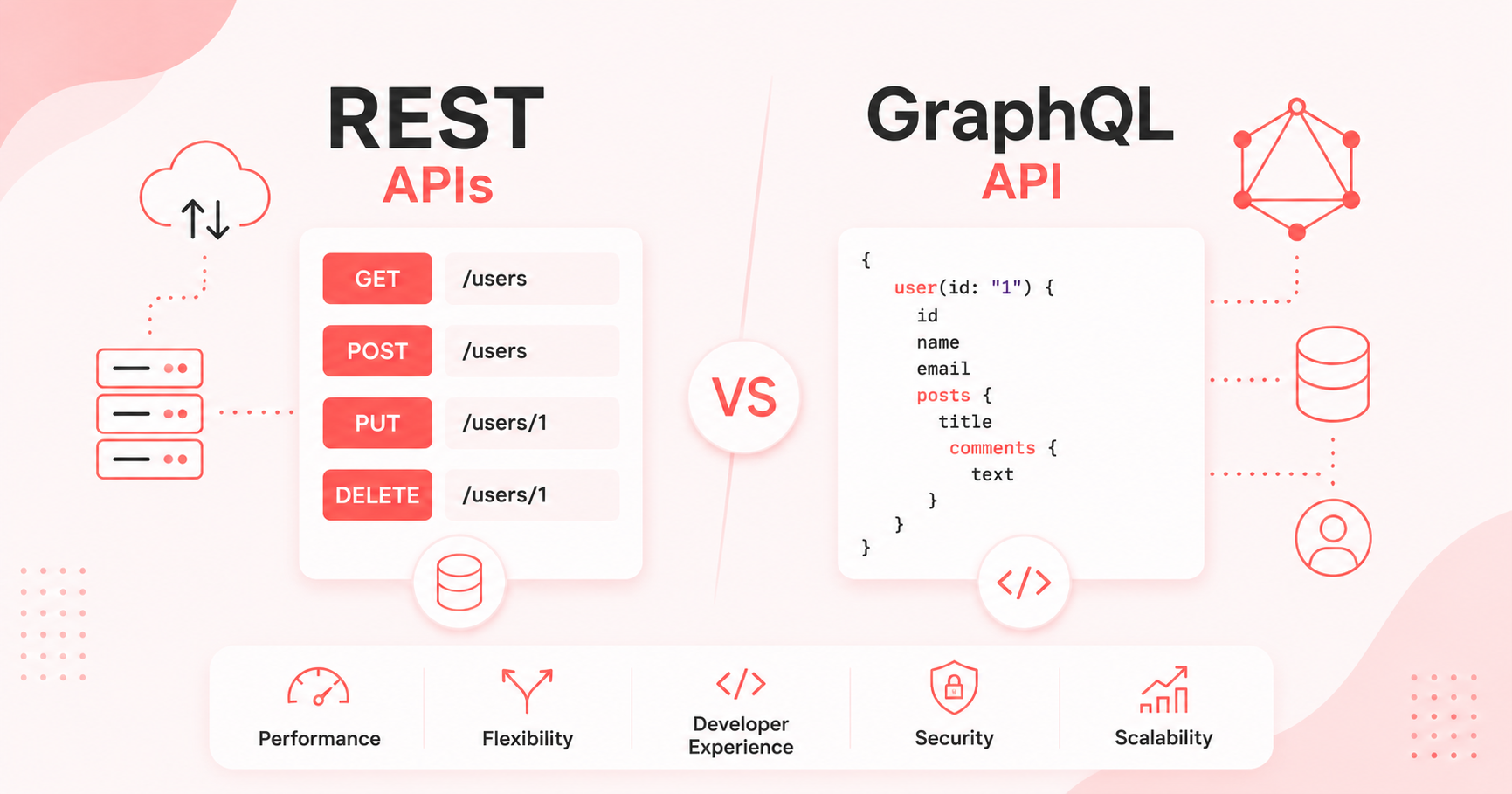
REST (Representational State Transfer) is an architectural style introduced by Roy Fielding in 2000 that has become a standard for designing networked applications. RESTful APIs use HTTP protocols and standard methods—GET, POST, PUT, DELETE—to interact with resources, which are identified by URLs.
Core Principles of REST
- Statelessness: Each request from client to server must contain all the information needed to understand and process it. The server does not store client context between requests.
- Resource-Based: Everything in REST is a resource accessible via a specific URI (Uniform Resource Identifier).
- Uniform Interface: REST APIs expose a consistent interface for clients, simplifying interactions.
- Client-Server Separation: The client and server operate independently, allowing flexibility in development.
- Cacheability: Responses can be explicitly marked as cacheable or not, improving efficiency.
- Layered System: The architecture can include intermediaries like proxies, gateways, or load balancers to enhance scalability.
How REST Works in Practice
In REST, resources are manipulated through standard HTTP methods:
- GET: Retrieve a resource or a collection.
- POST: Create a new resource.
- PUT/PATCH: Update an existing resource.
- DELETE: Remove a resource.
For example, to get user data, you might call GET /users/123. To update user details, you might send a PUT /users/123 with the updated data.
Advantages of REST
- Simplicity and widespread adoption.
- Clear resource-oriented design.
- Built on standard HTTP protocols and verbs.
- Easy to cache and scale.
Limitations of REST
- Over-fetching or under-fetching data as clients receive fixed data structures.
- Multiple round-trips may be needed to fetch related resources.
- Versioning REST APIs can be complex.
- Inflexibility in evolving data requirements.
What is GraphQL?
GraphQL is a query language and runtime for APIs developed by Facebook in 2012 and publicly released in 2015. It provides a more flexible approach to API design by allowing clients to specify exactly what data they need, rather than receiving predefined data structures.
Core Features of GraphQL
- Single Endpoint: Unlike REST’s multiple resource URLs, GraphQL operates through a single endpoint, typically
/graphql. - Declarative Data Fetching: Clients define queries specifying fields and nested relationships they want.
- Strongly Typed Schema: The API is defined by a schema using types, enabling introspection and validation.
- Real-Time Support: Built-in support for subscriptions enables real-time data updates.
- Hierarchical Structure: Queries mirror data structure, retrieving nested data in a single request.
How GraphQL Works in Practice
A client querying user data might send:
{
  user(id: "123") {
    id
    name
    posts {
      title
      comments {
        text
      }
    }
  }
}
This query retrieves the user’s ID, name, their posts’ titles, and the comments’ texts—all in one request.
Advantages of GraphQL
- Precise data fetching reduces over-fetching and under-fetching.
- Single request for complex, nested data.
- Self-documenting via introspection.
- Evolves APIs without versioning.
- Enables rich developer tools and code generation.
Limitations of GraphQL
- Complexity in caching at the network level.
- Requires more sophisticated server implementations.
- Potential for overly complex queries impacting performance.
- Learning curve compared to REST.
Key Differences
Understanding the fundamental differences between REST and GraphQL helps clarify when to use each.
| Aspect | REST | GraphQL |
|---|---|---|
| Endpoint Structure | Multiple endpoints per resource | Single endpoint for all queries |
| Data Fetching | Fixed data per endpoint, may cause over/under-fetching | Client specifies exact data shape |
| Request Structure | Multiple requests to fetch related resources | Single request can fetch nested data |
| Versioning | Versioned APIs (v1, v2, etc.) | Schema evolves, no versioning needed |
| Caching | HTTP caching supported natively | Caching more complex, typically client-side or custom solutions |
| Flexibility | Less flexible, fixed structure | Highly flexible and adaptable |
| Learning Curve | Easier for beginners | Steeper learning curve |
| Error Handling | Uses HTTP status codes | Errors returned in response payload |
| Tooling | Mature and widespread | Growing ecosystem with strong introspection support |
| Real-time Support | Typically via WebSockets or other protocols | Built-in subscriptions |
Data Fetching Paradigm
One of the most discussed differences is over-fetching and under-fetching. In REST, clients may receive more data than necessary or require multiple calls to get related resources. GraphQL eliminates this by allowing clients to ask precisely for what they need.
Versioning vs Schema Evolution
REST APIs commonly version endpoints to handle changes, which can complicate maintenance. GraphQL uses a single evolving schema, enabling new fields to be added without breaking existing clients.
Performance Comparison
Performance depends heavily on application context, but some general observations apply.
REST Performance
- Straightforward caching via HTTP headers improves response times.
- Multiple endpoint calls may increase latency when fetching nested resources.
- Lightweight payloads per request if designed well.
GraphQL Performance
- Single request can reduce network round-trips, improving perceived speed.
- Complex queries may increase server processing time.
- Requires custom caching strategies (e.g., persisted queries, client-side caching).
- Batch requests or query complexity limits can mitigate performance bottlenecks.
In scenarios with complex relational data needs, GraphQL often outperforms REST by minimizing the number of requests. However, poorly designed GraphQL queries can degrade performance.
Scalability & Flexibility
REST Scalability
REST’s statelessness and caching capabilities allow easy horizontal scaling. Servers can be load balanced without session affinity. However, managing multiple endpoints and versioning may complicate scaling API teams and infrastructure.
GraphQL Scalability
GraphQL’s flexibility supports rapid feature development and evolving data requirements without versioning overhead. However, implementing efficient query parsing, validation, and execution requires more sophisticated infrastructure. Rate limiting and query complexity analysis are essential to prevent abuse and preserve scalability.
GraphQL’s single endpoint can become a bottleneck without proper load balancing and caching strategies but enables fine-grained control over data retrieval.
Security Considerations
Both REST and GraphQL require rigorous security practices, but their differences pose unique challenges.
REST Security
- Uses standard HTTP methods, status codes, and authentication mechanisms (OAuth, JWT).
- Caching proxies and firewalls can be configured easily.
- Endpoint-based access control simplifies permission management.
GraphQL Security
- Single endpoint exposes all data types and queries—requires careful schema design.
- Query complexity and depth limits help prevent denial-of-service attacks.
- Fine-grained authorization within resolvers is essential.
- Introspection can expose schema details; disable in production if needed.
Both approaches benefit from HTTPS, authentication, input validation, and monitoring for anomalies.
Developer Experience
REST Developer Experience
- Familiar and mature ecosystem with extensive documentation and tools.
- Tools like Postman and Swagger/OpenAPI simplify API testing and documentation.
- Clear resource-based design reduces initial complexity.
GraphQL Developer Experience
- Strongly typed schema enables auto-completion, validation, and better editor support.
- Single endpoint with declarative queries enhances speed of development.
- Interactive tools like GraphiQL or Apollo Studio empower experimentation.
- Evolving community and ecosystem with frequent improvements.
While GraphQL can have a steeper learning curve, many developers find its flexibility and tooling improve productivity over time.
Use Cases
When to Use REST
- Simple CRUD applications with well-defined resource boundaries.
- Applications requiring robust caching at the HTTP level.
- Projects where widespread client support and simplicity matter.
- Public APIs needing stable versioning.
When to Use GraphQL
- Complex applications requiring nested or relational data fetching.
- Rapidly evolving products needing flexible, incremental schema changes.
- Mobile or single-page applications where minimizing network requests is critical.
- Projects benefiting from strong developer tooling and introspection.
Which Should You Choose?
Choosing between GraphQL and REST depends on your project needs, team expertise, and future plans.
- If your application requires simple, stable, and cache-friendly APIs, REST is a solid choice.
- If your app demands flexible, efficient data fetching with rapid iteration, GraphQL may provide a better development experience.
- Consider hybrid approaches too; some projects use GraphQL as a gateway over REST services to combine strengths.
Evaluate your data complexity, client requirements, and operational constraints before deciding.
Frequently Asked Questions (FAQs)
Conclusion
Both REST and GraphQL are powerful API paradigms shaping modern web development. REST offers simplicity, maturity, and stability, while GraphQL delivers flexibility, efficiency, and developer empowerment. Understanding their differences, strengths, and trade-offs will help you build scalable, secure, and performant APIs tailored to your project’s unique demands.
Choose thoughtfully, implement carefully, and your API will become a cornerstone of your application’s success.